
Key takeaways
- One active SIM ≈ 1,800 unique IPv4 addresses a quarter (~220 a week, ~830 a month) — not the “millions” you see advertised.
- “Millions” is a vanity metric. Our whole network has served tens of millions of distinct IPs, but you only ever touch your SIM’s share — per-SIM depth is what protects accounts.
- Carrier × location is the real lever — it decides your numbers far more than any headline pool size; country is only the coarsest cut of location.
- Read depth as yield, not raw count — fresh IPv4 addresses per rotation runs ~99% on the deepest pools down to ~5% on a small block hammered thousands of times; a big quarterly total is often just heavy rotation.
- “No rotation” usually means a good, lightly loaded pool — not a broken one. Airplane-mode rotation works because a busy pool reassigns your address within seconds of you going offline; a light pool has nobody waiting for it, so it hands the same address back — sometimes for months. That’s a sticky, lived-in carrier IP at SIM-card price: a feature for long-lived accounts, a fault only if you wanted freshness.
- Your IP is effectively 1-to-1 with your session — about 96% of the time over six months a public IPv4 address is held by a single connection (IPv6: ~99.7%; how we measured ), so you’re not “hidden in a crowd.” Account safety comes from carrier trust and consistency.
- First-party data: over a billion IP-change events, analyzed across a clean ~50-million-event sample over 90 days, measured on our own infrastructure.
“How many IPs?” is the wrong question
A single active mobile SIM realizes a median of ~1,800 unique IPv4 addresses per quarter — about 220 a week, 830 a month — measured across a sample of ~5,000 daily-active SIMs on our network. That per-SIM depth, not a provider’s headline pool, is the mobile proxy IP pool size you actually buy.
Almost every mobile-proxy provider advertises the same headline: millions of IP addresses. It sounds decisive, and it tells you almost nothing.
Here is why. Across our history, iProxy.online’s entire network — every SIM, every carrier, every country — has served tens of millions of distinct IPv4 addresses (millions in a single month). So yes, “millions” is technically true for us too. But you will never touch the whole network on one connection, and neither will anyone using a competitor’s “millions.” The size of a pool you cannot reach is a vanity metric.
What actually keeps an account alive is narrower and more practical:
- Is the IP a real carrier IP? Platform trust and reputation systems weight an address by where it originates — a mobile carrier’s autonomous system (ASN) reads as an ordinary phone user; datacenter ranges dressed up as residential do not.
- Is it consistent when you need it to be? A long-lived account wants the same geography and a stable footprint over time — not a new country every hour.
- Can you get a fresh one on demand? When you do want to rotate, a clean, not-recently-used IP should be one tap away.
None of that is measured by the pool’s headline size. It is measured by the depth and behavior of your SIM — and that is driven almost entirely by the carrier and country it sits on.
This article opens our data. We will define what a mobile IP pool really is, show how many unique IPv4 addresses an active connection genuinely yields over a week, a month, and a quarter, explain why a carrier’s real depth is its yield rather than its raw count, break the numbers down by carrier, country, and US region, explain how fast IPs rotate and how often they repeat, and finish with a plain decision matrix: which SIM for which job. Every number below is first-party and measured, not marketing. If you pick carriers and tune rotation for a living — managing multiple accounts, verifying how ads and content render by region, market research, or reselling proxy access — these are the numbers to plan around.
What a mobile IP pool actually is
A mobile IP pool is the set of public IPv4 and IPv6 addresses a carrier can assign to a SIM in a given area. When your SIM attaches to the data network, the carrier hands it one public address from that pool. When the session re-establishes — or you trigger a rotation — you may get a different one.
It is worth correcting a myth that shows up in a lot of proxy marketing (including, frankly, older versions of this very page): the idea that “mobile carriers use NAT, so your public IP is shared with lots of other subscribers at the same time.”
On modern consumer mobile networks, that is generally not how it works:
- At any given moment, your public IP is effectively 1-to-1 with your session. The carrier assigns it to your SIM, and it is yours until the carrier rotates it or you detach. Simultaneous sharing of one public IP across many distinct subscribers is the exception, not the rule.
- Some low-pool carriers force temporal rotation. They may reassign your public IP every few minutes, every few requests, or on each reconnect. That is your address changing over time — not multiple people sitting behind one address at once.
- What platform trust and recommendation systems read is the carrier ASN, the geographic consistency of your IP per account, how often your account’s address changes against what is normal for a mobile network, and the device and behavior layer. Whether the address is exclusively yours at any given instant is not one of the signals; whether your account’s footprint is stable over time is — which is exactly why a sticky line helps an aged account.
That last point is worth dwelling on, because it explains why mobile IPs are worth paying for at all. Only one rung of the address-trust ladder is fixed: datacenter and hosting ranges sit at the bottom — cheap, abundant, trivially identifiable, and cheap to block wholesale. Above that there is no universal top; platforms grade fixed-line residential and mobile-carrier ranges differently per action. A home broadband address offers stable per-IP history and precise geography: the profile payment and checkout systems favor. A mobile-carrier address offers the organic profile of a phone plus a blocking cost: the same IPv4 passes through many real subscribers over the weeks, so an IP-level ban placed today lands on innocent users tomorrow — platforms know it and lean on account-level signals instead. An address that announces from a carrier ASN, in a plausible location, with consistent per-account behavior, reads as what it is: a real person on a real phone. That trust comes from the ASN and the per-account consistency over time, not from the address being exclusively yours at any instant.
This matters for how you should think about the product. The iProxy endpoint is dedicated to your device — the phone running our app is yours alone. The public IP comes from the carrier’s pool, is normally yours for the session, and rotates on a schedule you can largely control. The value is not “an exclusive IP no human ever uses”; it is a real carrier IP, with consistent geography per account, that you can refresh on demand.
One SIM, one IP: the part the myths get wrong
Because the public IP is effectively 1-to-1 with your session, two truths follow that the marketing usually gets backwards — one an advantage it undersells, one a danger it oversells. Both matter.
Your IP is yours — and that’s the real advantage. The claim is about who, not for how long: for whatever stretch the carrier has the address assigned to you, nobody else is using it — true for about 96% of public IPv4 assignments on our network over six months of data, and 99.7% where carriers expose IPv6. How long that stretch lasts is a separate axis entirely — stickiness and rotation (covered below). You don’t inherit whatever the last tenant of a shared datacenter proxy did, and no crowd of strangers is burning its trust while you work — its reputation is effectively its own.
And it matches what the market already treats as the gold standard — for far less. The most-prized residential proxy is a sticky home IP that holds for months: a “family IP” a few real people actually live behind, trusted precisely because it’s lived-in — a real household’s organic traffic, not a sterile address with no human history behind it. Ethically sourced, that gets expensive, and “rotating” it really means hopping onto some other household’s line. A mobile carrier IP gives you the same lived-in, real-human trust — on a carrier ASN instead of a stranger’s household — except it’s a line you actually control and rotate on demand, and it costs far less for any real volume because we don’t bill you by the gigabyte the way usage-metered residential plans do.
You are not “hiding in a crowd” — and betting on that is dangerous. A stubborn myth says mobile IPs make you anonymous because “hundreds of people share one IP, so no platform can pick you out.” That is almost never how it works: the great majority of the time it is one SIM, one IP, just you, and you are individually attributable on that address. Anonymity and account safety do not come from blending into simultaneous strangers — they come from a trusted carrier ASN, consistent per-account geography, clean separation between identities, and sensible rotation. If your operational-security plan is “the crowd will hide me,” you do not have one. The mobile IP buys you trust and a line of your own, not invisibility.
Two terms you will see throughout the rest of this article:
- ASN / carrier subnet — the block of addresses a carrier announces. When your IP changes, it usually changes within the carrier’s own ranges, which is why the geography and trust signals stay stable even as the last digits move.
- Yield — for every rotation your SIM performs, how often it lands on an IP it has not seen before. High yield means a deep, fresh pool; low yield means you are churning a small block. Yield is the honest measure of pool depth because it does not reward simply rotating more.
The same holds — even more so — for IPv6. As of June 2026 our IPv6 support is narrower than IPv4, so this report measures IPv4 end to end. Where IPv6 is available the early data is striking: nearly every rotation lands on a fresh address (yield close to 99%), the address pool is effectively unbounded, and at any given instant a public IPv6 is held by a single connection about 99.7% of the time — even closer to true one-to-one than IPv4. That freshness is architectural, not an operator choice: a mobile device gets an entire fresh /64 prefix each time it attaches , there is no NAT layer to anchor to, and the phone itself randomizes its address within the prefix (privacy extensions).
How many unique IPs you actually get
Every per-SIM count in this article is of IPv4 addresses — that is what we measure end to end; IPv6 is the separate, near-unbounded story summarized above.
Here is the headline, measured on daily-active connections — a sample of about 5,000 SIMs that were active on at least 60 distinct days over the quarter and rotated heavily (roughly 10+ times a day):
| Window | Median unique IPv4 addresses per SIM |
|---|---|
| 7 days | 223 |
| 30 days | 830 |
| 90 days | 1,796 |
So a single SIM, used in earnest, realizes on the order of ~220 fresh IPv4 addresses a week, ~830 a month, and ~1,800 a quarter. One subscription. One SIM.
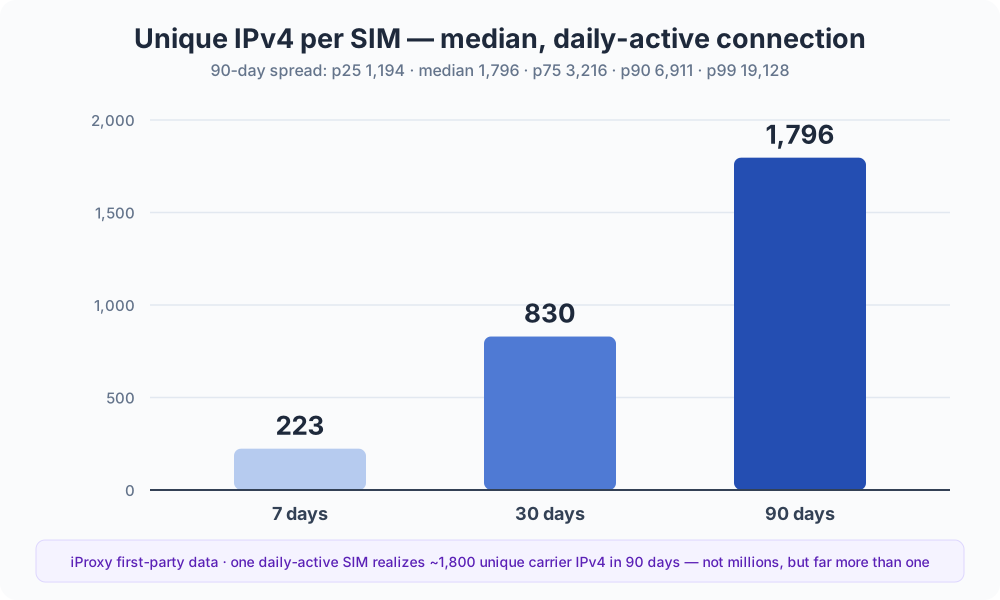 Cohort: a sample of ~5,000 daily-active SIMs (active on ≥60 distinct days, rotating ~10+×/day); 90-day window. Realized counts — cadence-dependent.
Medians hide the spread, and the spread is wide because rotation settings and carrier differ enormously. Across the same cohort, distinct IPs over 90 days break down like this:
| Percentile | Unique IPv4 addresses / 90 days |
|---|---|
| 25th | 1,194 |
| 50th (median) | 1,796 |
| 75th | 3,216 |
| 90th | 6,911 |
| 99th | 19,128 |
Bucketed the same way, here is what share of those active SIMs lands in each band over the quarter:
| 90-day unique IPv4 addresses | Share of active SIMs |
|---|---|
| under 250 | 1.5% |
| 250–500 | 2.7% |
| 500–1,000 | 13.7% |
| 1,000–2,000 (median band) | 37.9% |
| 2,000–4,000 | 24.5% |
| 4,000–8,000 | 11.2% |
| 8,000 or more | 8.6% |
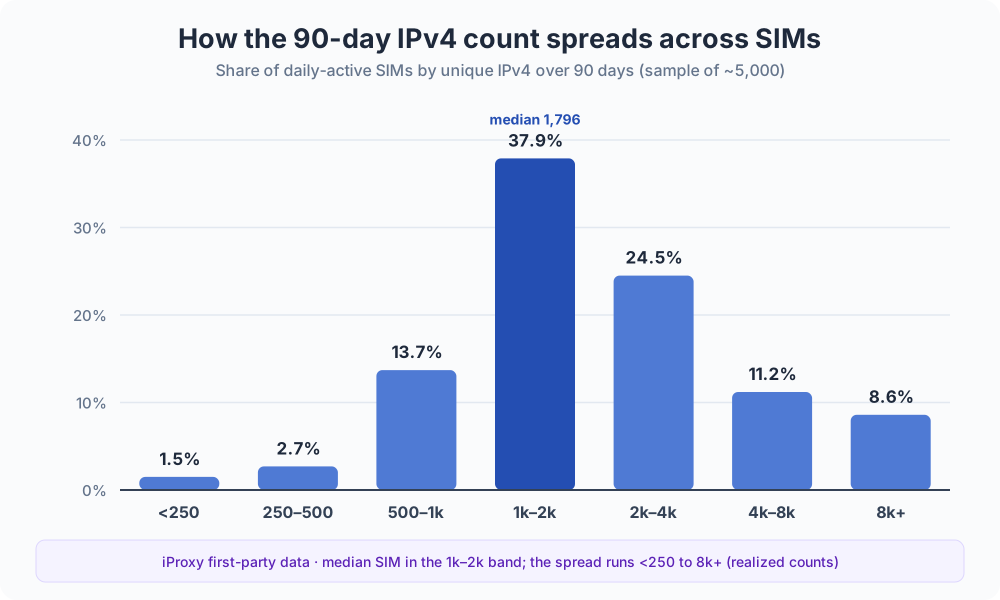 Same cohort (sample of ~5,000). Bars are the share of SIMs in each band; these are realized counts, so the spread is partly carrier and country, partly how hard each SIM rotates.
In other words: a quarter of the ~5,000 daily-active SIMs in this sample see fewer than ~1,200 IPv4 addresses over three months; the typical one sees ~1,800; the top 10% blow past 6,900; and the most aggressively-rotated connections clear 19,000. None of these connections are doing anything exotic — they are simply on different carriers, in different countries, with different rotation cadences.
A word on what these numbers are and are not, because it governs everything that follows. They are realized counts from real customer usage — what active SIMs actually saw — not a theoretical carrier maximum and not a forced “rotate as fast as possible” benchmark. That makes them honest, but it also makes them cadence-dependent: a SIM that rotates every two minutes will show a far bigger count than an identical SIM on the same carrier that rotates once a day, even though the carrier’s pool is the same. So a realized count tells you what a connection did, not what a carrier is. To compare carriers fairly, we need to divide out the rotation — which is exactly what yield does, and what the next section is built on.
The practical point bears repeating against the “millions” framing: ~1,800 distinct, real, carrier-grade IPs from one SIM over a quarter is not a small number for managing accounts. It is more than enough for almost any multi-account management , ad-verification, or market-research workflow — and every one of them is a genuine mobile IP, not a line item in a pool you will never reach.
Big, but finite
The pool is deep. It is not infinite, and we will not pretend otherwise.
If you take a long-lived connection and track its cumulative unique IPv4 addresses day by day, the curve looks like this (median connection, present for the full quarter):
| Day | Cumulative unique IPv4 addresses |
|---|---|
| 1 | 31 |
| 7 | 210 |
| 30 | 798 |
| 60 | 1,439 |
| 90 | 1,796 |
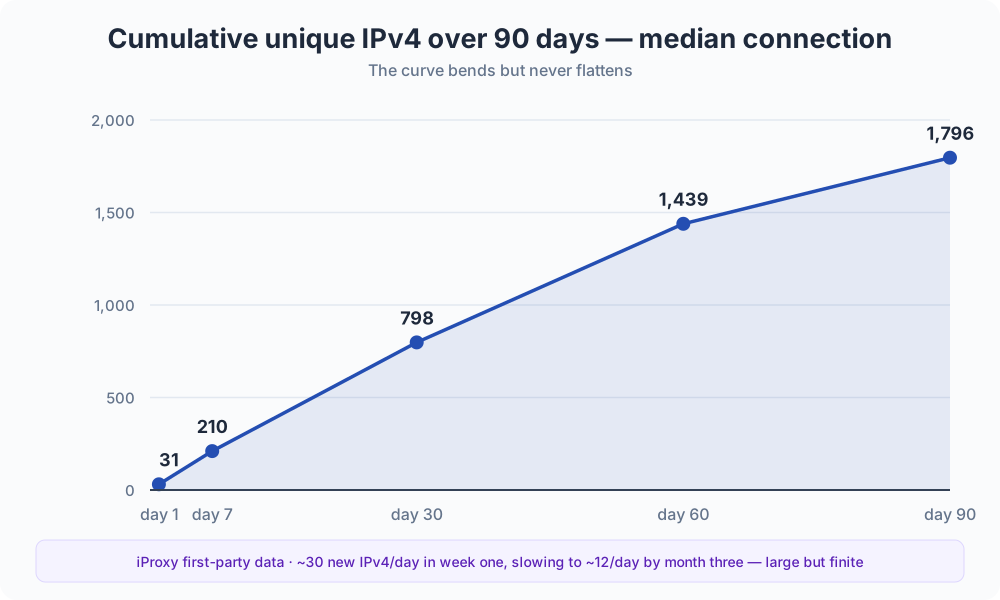 Median connection present for the full quarter; cumulative distinct IPv4 addresses. Realized — cadence-dependent.
The shape is the story. In week one you discover new IPv4 addresses fast — about 30 a day. By the third month, the rate of new IPs has slowed to roughly 12 a day. The curve flattens, but it never goes flat: even at 90 days you are still turning up addresses you have not seen before.
That is what “large but finite” means in practice. You will not exhaust a real carrier’s reachable pool in a month of normal rotation — but you also will not see brand-new addresses at the same breakneck rate forever. The supply is deep enough that exhaustion is not a practical concern for ordinary multi-account work, and the network-wide figure (tens of millions of distinct IPv4 addresses) confirms there is a very large ceiling above any single connection.
Why does the per-SIM curve flatten while the network stays huge? Your SIM never draws from a global address space. When a session attaches, the carrier’s packet core — the LTE P-GW or 5G SMF/UPF — assigns a public address from a finite pool tied to your APN, gateway path, and region, and carrier-grade NAT keeps the visible set of public addresses deliberately small. You are sampling a bounded set: at first almost every rotation is a new address; once you have seen most of what your gateway path routinely exposes, the discovery rate has to fall — the coupon-collector effect of sampling any finite set.
Addresses keep trickling in past month one because these pools are not static: carriers allocate, withdraw, and rebalance address “chunks” across gateways as demand shifts , so the reachable set slowly breathes rather than sitting frozen. One honest limit: from egress IPv4 addresses alone we can see the trickle but cannot fully separate ordinary lease churn — addresses we simply had not drawn yet — from genuinely new capacity entering the pool, so we report the curve we measured, not a claim about why each new address appears. Move the SIM to another location or change the carrier, and you draw from a different pool entirely. Which brings us to the lever that matters most.
The real lever: carrier × location (read through yield)
If you change one thing to change your numbers, change the carrier your SIM sits on — and where it physically sits. It dwarfs every other factor. But you have to read it correctly, and that means dropping raw counts in favor of two cadence-free measures:
- Yield — of every rotation the SIM performs, the share that lands on an IP it has not already seen. This is pool depth with the rotation divided out: a deep, fresh pool yields near 100%; a small block yields a sliver no matter how often you rotate.
- 24-hour repeat rate — the share of rotations that return to an address the SIM held within the last day. This is short-term freshness, and it moves independently of long-run depth.
Here is why the distinction matters. The single most over-stated metric in this industry is the per-SIM count, and it is over-stated because heavy rotation inflates it:
| Carrier (country) | Fresh-IPv4 yield | 24h repeat | Median rotations / SIM | Realized IPv4 / 90d* | Sample |
|---|---|---|---|---|---|
| Free Mobile (FR) | 99% | 1.1% | 3,941 | 3,923 | solid |
| O2 / Telefónica (DE) | 95% | 3.2% | 1,265 | 1,186 | deep |
| Vodafone Italia (IT) | 95% | 3.3% | 1,170 | 1,062 | solid |
| Verizon (US) | 68% | 12.2% | 2,886 | 1,808 | deep |
| Polkomtel (PL) | 52% | 7.6% | 11,423 | 5,043 | solid |
| T-Mobile (US) | 38% | 22.8% | 3,815 | 1,420 | deep |
| AT&T (US) | 13% | 37.2% | 3,192 | 621 | deep |
| Three (UK) | 5% | 79.3% | 13,696 | 1,132 | solid |
*Realized = what those SIMs actually saw at their own rotation rate — a usage outcome, not a carrier capability. Yield, rotations and realized are each independent per-SIM medians (so realized ≈ yield × rotations only loosely). Every row clears the ≥15-SIM, ≥100-rotation gate; the Sample column is its depth tier — deep (≥200 SIMs) / solid (50–199) / gate-met (15–49).
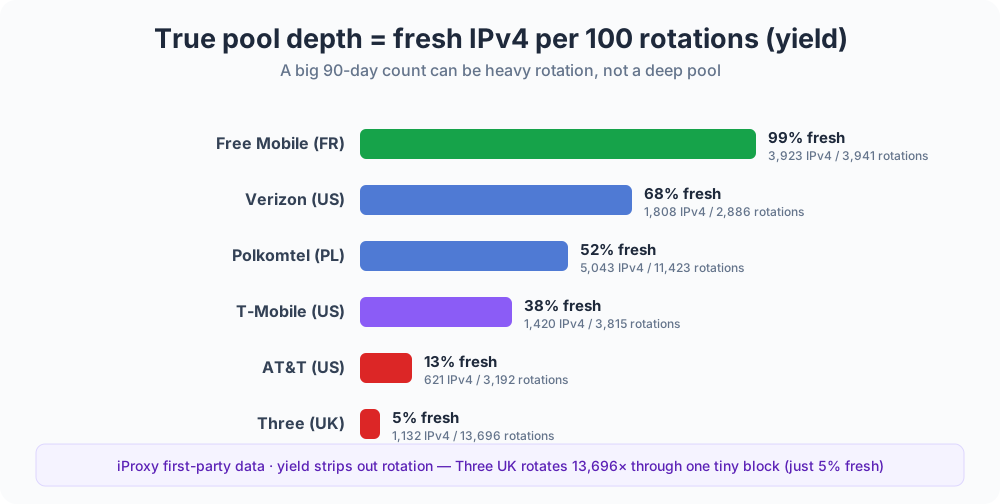 Per-carrier medians over connections with ≥100 rotations, ≥15 SIMs each. Yield = distinct IPv4 ÷ rotations (cadence-free).
Read the table top to bottom and the “biggest pool” story falls apart. Polkomtel posts one of the largest realized counts here — about 5,043 IPv4 addresses in 90 days — and a tempting buyer would stop there. But that number comes from those SIMs rotating about 11,400 times; the pool’s actual yield is 52%, so half of every rotation is wasted on an address it had already seen. Three UK is starker still: a respectable-looking 1,132 addresses, produced by a median 13,696 rotations through a block so small the yield is 5% — you change addresses constantly and almost never see a new one. Meanwhile Free Mobile and O2/Telefónica turn nearly every rotation into a fresh IP (99% and 95% yield); that is what a genuinely deep pool looks like.
Now layer in the second axis. Yield and 24-hour repeat do not move together. Polkomtel has only mid yield (52%) yet a low same-day repeat (7.6%) — over a single day its rotations rarely recycle, even though across the quarter it saturates. Deutsche Telekom is the mirror image: high yield (74%) but a 22.7% same-day repeat, so it reaches plenty of distinct IPs over time while recycling more often within any given day. If your work is bursty — a heavy day, then quiet — the 24-hour repeat is what bites you. If it is sustained over months, yield is what you should optimize. Most buyers conflate the two and overpay for a headline count that captures neither.
Step back from individual carriers to the whole customer base, and the same yield measure splits connections into two camps:
| Fresh-IPv4 yield | Share of connections |
|---|---|
| 0–10% | 9.3% |
| 10–20% | 10.0% |
| 20–30% | 7.2% |
| 30–40% | 7.2% |
| 40–50% | 7.7% |
| 50–60% | 8.6% |
| 60–70% | 9.0% |
| 70–80% | 9.1% |
| 80–90% | 10.8% |
| 90–100% | 21.2% |
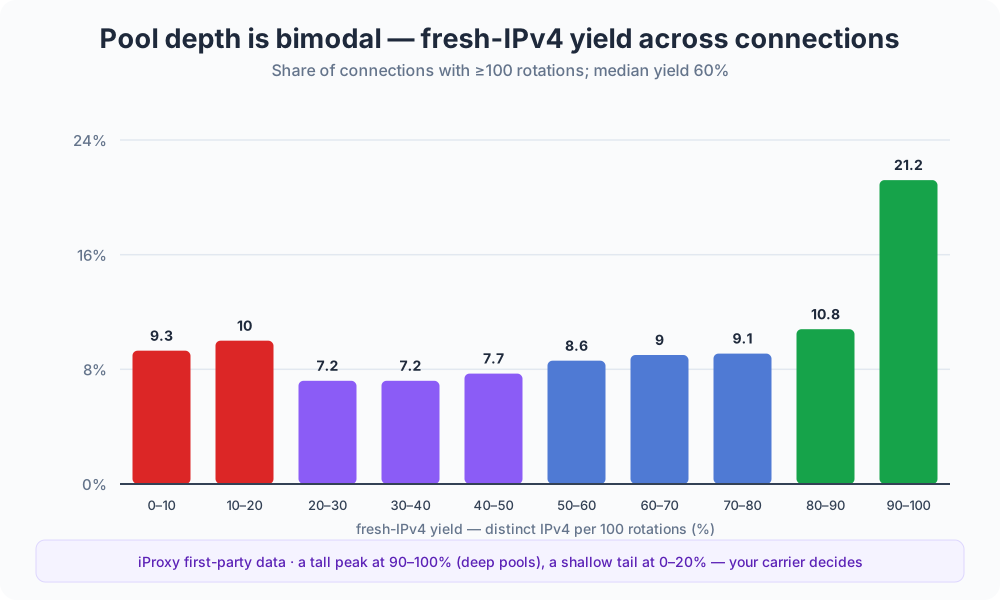 Connections with ≥100 rotations. Yield is cadence-free, so this is pool depth, not how hard anyone rotates.
The distribution is bimodal: the single biggest group (21%) lives at 90–100% yield — deep pools, almost every rotation fresh — while a real tail (about a fifth of connections) sits below 20%, churning shallow blocks. Almost nobody’s pool depth is mediocre by accident; you are mostly either on a deep carrier or a shallow one. Which camp you land in is set by the carrier and location you choose — not by how often you rotate.
What does “location” mean? In the tables above it means country — the grain this dataset is keyed to. In practice the real grain is finer: the pool your SIM draws from is tied to a gateway path and region, and those follow population density more than borders — in a metro the size of London or New York, the grain can be smaller than the city. We cannot show that in country-keyed tables, but we see it operationally: some customers physically relocate their devices — phones mounted in a vehicle, moved to a different part of the city every week or so — and draw on a noticeably different address set after each move. Same SIM, same carrier, new pool.
The takeaway for buyers: stop shopping for the biggest advertised pool. Shop for yield, and match the 24-hour repeat to how bursty your work is. The next two sections break that down for the regions our customers ask about most — Europe and the United States.
Europe deep-dive: operator × country
Europe is not one market. The same brand behaves completely differently across borders — but “Eastern Europe is deepest” turns out to be an artifact of how hard those SIMs rotate, not of the pools themselves.
Fresh-IPv4 yield, 24-hour repeat, and realized count per operator over 90 days — operators with ≥15 sampled SIMs (≥100 rotations each); sample-depth tier shown:
| Country | Operator | Yield | 24h repeat | Realized / 90d | Sample |
|---|---|---|---|---|---|
| France | Free Mobile | 99% | 1.1% | 3,923 | solid |
| Spain | XTRA / MásMóvil | 97% | 1.7% | 1,652 | gate-met |
| Germany | O2 / Telefónica | 95% | 3.2% | 1,186 | deep |
| Italy | Vodafone Italia | 95% | 3.3% | 1,062 | solid |
| France | Bouygues Telecom | 90% | 7.1% | 2,403 | gate-met |
| Germany | Deutsche Telekom | 74% | 22.7% | 1,214 | solid |
| Germany | Vodafone DE | 57% | 15.5% | 842 | solid |
| Poland | Play (P4) | 54% | 13.5% | 2,666 | solid |
| France | Orange | 53% | 15.9% | 960 | solid |
| Poland | Polkomtel (Plus) | 52% | 7.6% | 5,043 | solid |
| Poland | Orange Polska | 49% | 9.8% | 3,533 | solid |
| Spain | Orange España | 37% | 68.2% | 638 | gate-met |
| Poland | T-Mobile PL | 27% | 33.9% | 1,503 | solid |
| France | SFR | 22% | 29.2% | 480 | solid |
| UK | Three | 5% | 79.3% | 1,132 | solid |
Two patterns jump out, and the first overturns conventional wisdom.
The deepest pools are Western European, not “the East.” Sort by yield and the leaders are Free Mobile (France), XTRA (Spain), O2 (Germany), and Vodafone Italia — all turning 95–99% of rotations into fresh IPs. Poland’s big realized counts (Polkomtel 5,043, Orange Polska 3,533) look impressive but sit at ~50% yield: those are heavily-rotated SIMs on moderate blocks, not the deepest pools. If you bought “Polish carriers for volume” off a raw-count table, you were paying for rotation, not depth.
The shallow end is unambiguous. Three UK (5% yield, 79% same-day repeat), SFR France (22%), and T-Mobile Poland (27%) cycle each SIM through a small reachable set — by assignment policy or by pool size; a feature if you want stickiness, a trap only if you’re buying freshness. Spain’s Orange España shows that trap perfectly: a real-looking 638-IPv4 count alongside a 68% same-day repeat, meaning two of every three rotations recycle within a day.
Notice the same brand splitting by country: Vodafone yields 95% in Italy but 57% in Germany; Orange yields 53% in France but 49% in Poland with very different repeat behavior. “Vodafone” tells you almost nothing about your pool; “Vodafone in which country” tells you almost everything.
A caveat in the interest of honesty: these figures come from a connection sample, and operators with fewer than ~15 sampled SIMs were left out for stability. A few markets we are asked about did not have enough sampled volume for stable medians, though their behavior often shows in the repeat data. If you remember one rule for Europe, drop “East for volume” and replace it with: sort by yield, then check the 24-hour repeat against how bursty your work is.
United States deep-dive: operator × region
The US is the cleanest illustration of why raw counts mislead — and of a reversal you would never see without dividing out rotation.
The old way to tell this story was “unique IPs per day,” and by that measure T-Mobile lines on the Northeast corridor looked like the runaway leaders, churning into the low hundreds of addresses per day. But that is rotation volume, not pool depth: those SIMs simply rotate hardest. Switch to yield — fresh IPv4 addresses per 100 rotations, by carrier and longitude-based region — and the ranking flips:
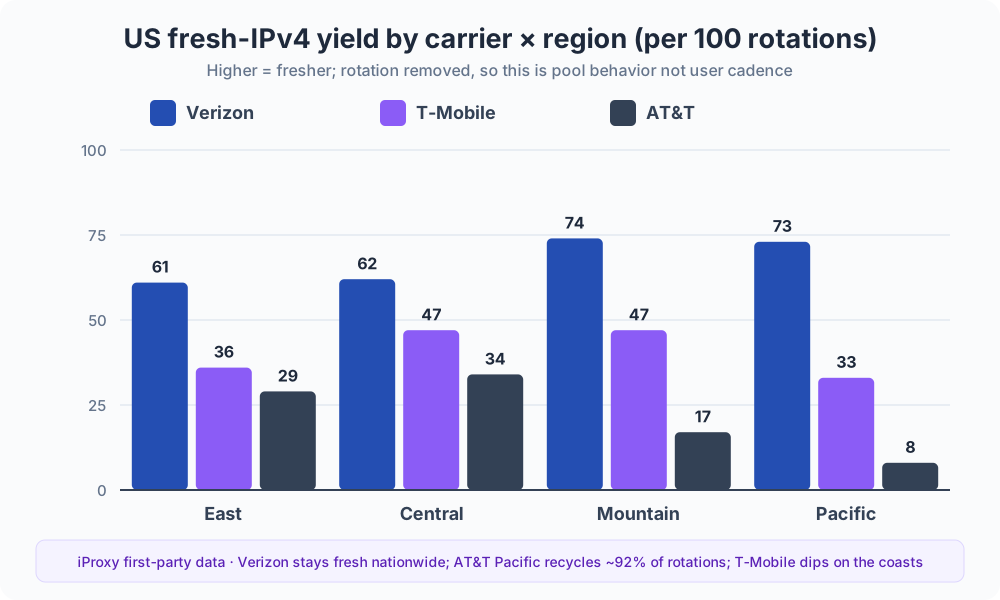 US connections with ≥100 rotations; region = longitude band of the connection’s geolocated IPv4 addresses. Every carrier×region cell clears the ≥15-SIM gate — Verizon’s cells are the deepest, AT&T’s western cells nearest the floor.
| Operator | East | Central | Mountain | Pacific | Sample |
|---|---|---|---|---|---|
| Verizon | 61% | 62% | 74% | 73% | deep |
| T-Mobile | 36% | 47% | 47% | 33% | deep |
| AT&T | 29% | 34% | 17% | 8% | deep |
Three things stand out:
- Verizon is the consistent national pick. It yields 61–74% everywhere, freshest in the Mountain and Pacific West, with a low ~12% same-day repeat nationally. If you want predictable freshness without studying a metro map, this is it.
- T-Mobile recycles on the coasts. Its yield sags to 36% in the East and 33% on the Pacific — exactly the corridors that looked best under the old “IPs per day” lens. The high daily counts there were heavy rotation through a bounded block, not depth. Inland (Central, Mountain) T-Mobile is healthier at ~47%.
- AT&T is shallow, and worst in the Pacific. An 8% Pacific yield means roughly 92% of rotations recycle an address the SIM already had. No rotation setting fixes that; the block is small.
An honest note on geography. Our data does not contain official US state subdivisions — the source has no reliable state field, and ZIP and metro-code fields come back empty at the carrier level. So we use the carrier-reported city and a longitude-based region split (Eastern / Central / Mountain / Pacific). That is enough to expose the variation clearly, but we are not going to label a SIM “California vs. Texas” with precision we do not have. Where you see a region, it is derived from the geolocation of the observed IPv4 addresses, not a guarantee of the SIM’s physical position.
How fast your IP rotates
Pool depth and yield answer “how many.” This answers “how long does each IP last before it changes?” — and it is the metric most often reported wrong, because the obvious measurement is contaminated by your own settings.
If you simply take the median time a SIM holds an IP, you get numbers that cluster suspiciously at exactly 60, 300, and 600 seconds — across the dwell intervals in our 90-day logs, nearly a fifth land within ±5 seconds of one of those three round numbers. Networks do not reassign addresses on wall-clock minutes; schedulers do. A SIM rotating on a 60-second timer “holds” each IP for 60 seconds on every carrier on Earth. So median hold-time mostly measures the customer, not the network.
So we measured the two ends the customer cannot set, on two separate instruments. The floor — how fast a change can physically happen — comes from those rotation intervals. The ceiling — how long one address survives if you stop rotating — comes from a server-side probe that records connections’ exit IPs multiple times per minute: a full month of snapshots, sampled into thousands of connection×carrier segments, each observed for at least 24 hours, holds never stitched across a SIM or carrier change. One caveat up front: a line running through our app is never radio-idle — the tunnel’s keep-alive traffic keeps the data session attached — so these are ceilings for an active line, the state a working proxy actually lives in.
The floor is mechanical, not policy. A rotation is a radio detach and re-attach: the app’s own telemetry clocks the cycle at ~9 s median (p90 ~15–20 s), and the fastest production lines sustain a change every 20–50 seconds. Where a whole fleet’s dwells pin near 30 seconds — Canadian lines on Rogers and TELUS are the extreme, at median dwells of 33–35 s — the histogram shape gives the cause away: no spike at any round number, just a smooth pile-up at the radio’s cycle time. Those lines rotate back-to-back, as fast as the network re-attaches; nothing about the carrier limits them.
The ceiling is the end the carrier owns — and for a line that stays active, it comes in three shapes.
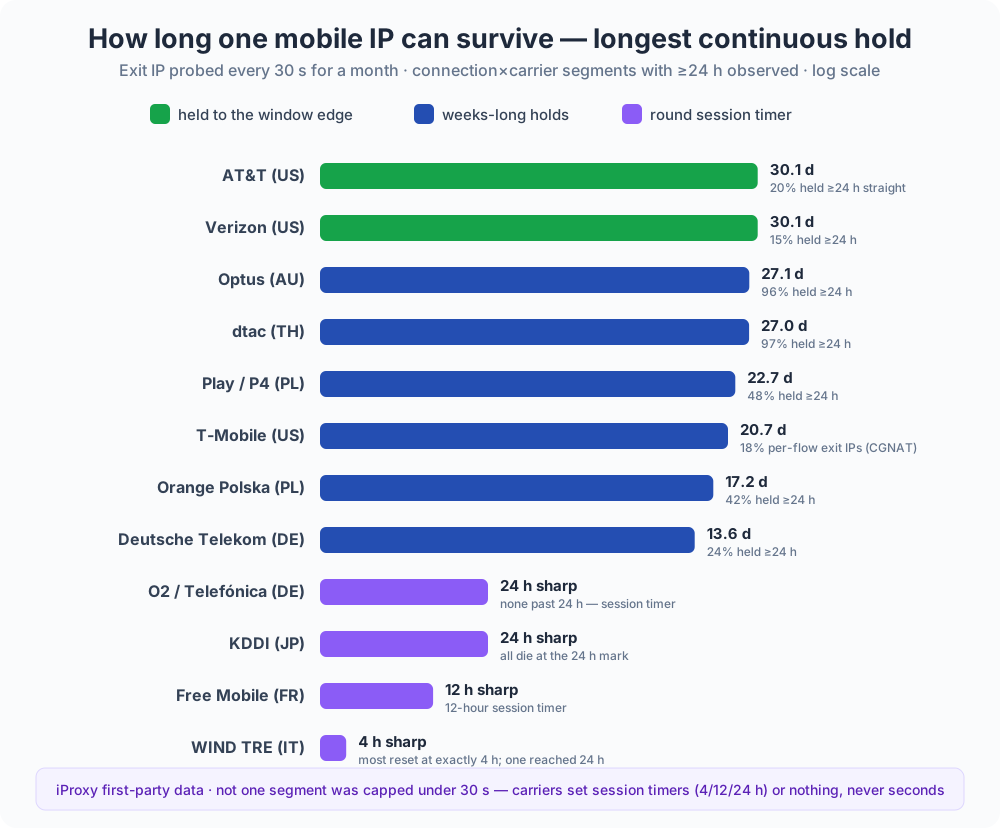 Connection×carrier segments with ≥24 h observed, ≥15 SIMs per carrier; probe granularity 30 s. The four Canadian carriers sit below the SIM gate (5–10 lines each) but all held for days — Rogers 24.6, Bell 12.0, Videotron 7.7, TELUS 3.1.
- No ceiling for an active line — most carriers. Stop rotating and, as long as the session stays attached, the address simply stays. The longest holds on Verizon and AT&T ran the full 30-day measurement window; the Polish big four reach 16–23 days; dtac Thailand 27. On networks like these, 15–97% of lines kept one IP for over 24 hours straight.
- A session timer — a visible minority. Every line dies at the same round number: 24 hours sharp on O2 Germany, SFR and KDDI, 12 hours on Free Mobile, 4 hours on WIND TRE. That is a session lifetime, not anti-hold policing — the line re-attaches in seconds, usually from a new address.
- Per-flow addressing — T-Mobile US, on ~18% of its lines. This is not rotation: the line is never touched, and a connection you keep open holds one IP for hours. On these lines the exit address belongs to the connection, not to the line — the carrier-grade NAT may stamp each new TCP session with a different IP from a ~1,000-address pool, whenever T-Mobile decides. No setting overrides it — our keep-alive mechanics are forceless on these lines. That is why an IP-checker, which opens a fresh connection per check, reports a thousand “changes” a day that never happened to the line itself. In practice: per-request traffic sprays across the pool — free diversity for volume work, useless for sticky sessions — while anything long-lived stays stable.
And the folklore version — the carrier rotates you every 30 seconds whether you like it or not — does not appear anywhere in our data. Setting aside the per-flow flappers (93% of them T-Mobile US), not one segment had its longest hold capped under 30 seconds, and exactly one stayed under two minutes. Every fast-churning line we inspected was churning because its owner told it to. The folklore does keep a kernel of truth — but it is about idle lines, not active ones: on some operators and regions with heavily loaded pools, a line that goes quiet can lose its address within ~15–60 seconds. Rare, but real. That idle-reclaim is exactly what the tunnel’s keep-alive prevents: a line that never looks idle never looks reclaimable.
So the knobs are:
- Rotation cadence — yours. A timer, the API, or an airplane-mode toggle rotates you as often as you like, down to the radio’s 20–50-second cycle. If toggles occasionally come back with the same address, lengthen the airplane-mode duration in the app’s connection settings so the pool has time to reclaim your old address. The carrier never forces you faster.
- Hold time — yours, up to the session timer. On most carriers a line you stop rotating keeps its address for days or weeks — the app’s keep-alive does the staying-active part for you; on the timer carriers it resets at 4, 12 or 24 hours.
- Pool depth — the carrier’s, captured by yield (the tables above).
And it is worth understanding why an airplane-mode toggle produces a new address at all, because the mechanism explains both ends of the spectrum. The toggle tears down your data session, and the address you were using goes back into the carrier’s local pool. What happens next depends entirely on how busy that pool is. On a heavily used pool, the address is claimed by another device within seconds — drop off the radio for ~20 seconds (airplane mode, an underground ride, leaving a dense city center) and it is gone; you reattach with whatever is free. Fast rotation is a side effect of pool pressure, not a favor the operator does you.
In fact, everything in carrier address management is engineered for stickiness, not rotation. The NAT standards recommend pinning each subscriber to a single external IP (changing it mid-session breaks applications), and widely deployed “deterministic” carrier NAT goes further — your public IPv4 is computed from your internal address, the same way every time, because that spares the operator per-connection logging. The only things that ever take your address away are another device needing it while you are offline or idle — or, on the session-timer carriers above, the timer expiring.
Invert that, and “no rotation” stops looking broken: on a lightly loaded pool nobody needs your address while you are away, so the carrier simply hands it back — rotation takes minutes, often returns the same IP, and a line may see only a handful of addresses a week no matter what you do. We watched one Vodafone Portugal line hold the same public IPv4 for six straight months across dozens of rotations (too few Portuguese lines to make our tables, but the pattern is unambiguous). Customers sometimes drop such carriers as “broken — no rotation.” They are not broken; they are the cheapest sticky carrier IP you can buy — the exact profile a long-lived account wants. Pick them for stability, not freshness.
The interaction is the whole game. Rotate aggressively on a high-yield carrier (Free Mobile, O2) and you get a flood of fresh, rarely-repeating IPs. Rotate aggressively on a low-yield carrier (Three UK, a shallow US metro) and you mostly churn the same small block — you change addresses constantly but see few new ones. More rotation does not create IPs the carrier’s block does not contain. Match the cadence to the yield, not the other way around.
Repeats, and the Unique IP feature
Because every carrier block is finite, rotation eventually circles back. Measured across the network over 90 days, the share of rotations that land on an IP the SIM already used within a rolling window is:
- Within 24 hours: 21.3%
- Within 48 hours: 29.5%
So about a fifth of naive rotations recycle a recent address within a day, and nearly a third within two. That is the network average — and as the carrier tables showed, it ranges from about 1% (Free Mobile, O2) to nearly 95% (COMCEL Colombia), with Three UK at 79%. On a shallow carrier, “rotate my IP” and “give me a new IP” are very different requests.
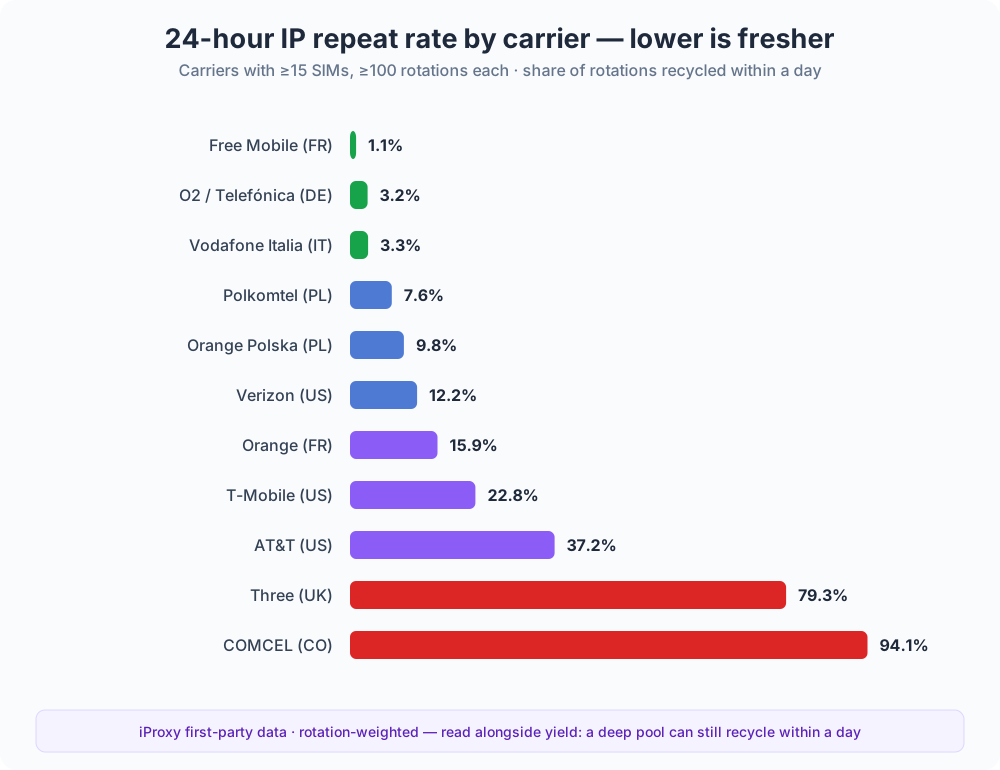 Carriers with ≥15 SIMs and ≥100 rotations each (thinner carriers omitted). 24h repeat is rotation-weighted — read it next to yield.
The full spectrum behind that chart, with the rotation volume and yield behind each rate:
| Carrier (country) | Sample | Median rotations / SIM | 24h repeat | Fresh-IPv4 yield |
|---|---|---|---|---|
| Free Mobile (FR) | solid | 3,941 | 1.1% | 99% |
| O2 / Telefónica (DE) | deep | 1,265 | 3.2% | 95% |
| Vodafone Italia (IT) | solid | 1,170 | 3.3% | 95% |
| Polkomtel (PL) | solid | 11,423 | 7.6% | 52% |
| Orange Polska (PL) | solid | 7,642 | 9.8% | 49% |
| Verizon (US) | deep | 2,886 | 12.2% | 68% |
| Orange (FR) | solid | 1,859 | 15.9% | 53% |
| T-Mobile (US) | deep | 3,815 | 22.8% | 38% |
| AT&T (US) | deep | 3,192 | 37.2% | 13% |
| Three (UK) | solid | 13,696 | 79.3% | 5% |
| COMCEL (CO) | gate-met | 2,045 | 94.1% | 8% |
Read it across, not just down: Three UK’s 79% same-day repeat is the product of hammering a tiny 5%-yield block a median 13,696 times per SIM — the repeat is high because the pool is shallow and the rotation is relentless. Free Mobile, rotating a healthy 3,941 times on a 99%-yield pool, recycles just 1%. High rotation plus a shallow block is what manufactures repeats; a deep pool absorbs even heavy rotation.
This is exactly what the dashboard’s Unique IP feature exists to fix. With it enabled, every rotation checks whether the new address has been seen within a lookback window; if it is a repeat, the system automatically triggers another change. The controls live under the connection’s Change IP settings:
- Lookback interval — how far back to consider an IP “recently used,” up to a maximum of 48 hours.
- Retries — how many additional airplane-mode toggles to attempt when it keeps hitting repeats, up to a maximum of 10.
Used well, Unique IP turns that 21–30% recycling rate down sharply, so the IPs reaching your target sites are genuinely fresh within your chosen window.
In practice, sensible starting points look like this. On a high-yield, low-repeat carrier (Free Mobile, O2), a 24-hour lookback with 3–5 retries is plenty — repeats are rare, so the retries almost never fire. On a mid carrier (Verizon, Deutsche Telekom), push the lookback toward 48 hours and allow the full retry budget, since recycling is more common. On a shallow carrier you have already lost the battle at the settings layer — the fix is to change the carrier, not the configuration.
And the honest limit: the feature minimizes repeats; it cannot manufacture uniqueness a carrier block does not contain. On Three UK at 79% repeat, or an AT&T SIM in a low-yield Pacific block, even ten retries cannot find a unique address that does not exist in the local pool. The real fix there is upstream — pair Unique IP with a higher-yield carrier and region. The feature and the carrier choice are partners, not substitutes.
Which SIM for which job
Put it all together and the buying decision stops being “who has the most IPs” and becomes “which carrier-country-region profile fits the work.” A rough matrix:
| Your job | What you want | Where to find it |
|---|---|---|
| Long-lived, stable accounts | Sticky mobile IP, consistent geography, low rotation | Low-rotation Western-EU lines (Vodafone DE); lightly loaded pools that anchor one address for months (e.g. Vodafone PT); sticky US metros that hold an address for weeks. Unique IP off. |
| High-volume fresh IPs (ad/content verification, market research, onboarding authorized accounts) | High yield, low repeat, fast cadence | Free Mobile (FR), O2 (DE), Vodafone Italia. Unique IP on, short lookback. |
| Balanced multi-account | Predictable, moderate rotation, national consistency | Verizon (61–74% yield, ~12% repeat nationwide), Deutsche Telekom. Unique IP on, 24h lookback. |
| Bursty work (heavy day, then quiet) | Low same-day repeat above all | Polkomtel (PL) — 7.6% 24h repeat despite mid yield. Unique IP on. |
A cheat sheet for the two axes:
- Want stability? Pick a low-rotation carrier and rotate rarely. The same real carrier IP and geography over weeks is a trust asset for an aged account.
- Want freshness? Pick a high-yield carrier and rotate often, with Unique IP enabled. You will see hundreds of new addresses a week.
Most serious operators do not pick a single profile — they run a small fleet of SIMs , each matched to a tier of accounts: a couple of sticky lines for aged, high-value identities, and several high-yield rotating lines for everything that needs volume and freshness.
The thesis, restated: the winning move is not a giant vanity pool you will never reach, and it is not the carrier with the biggest raw count. It is one SIM, chosen for high yield in the country and region that match your job — and tuned with rotation and Unique IP settings. A well-chosen single SIM, yielding ~1,800 IPv4 addresses per quarter, beats a “millions of IPs” claim you cannot act on.
How we measured this
Everything above is first-party, queried read-only from one source of truth: our IP-change history — over a billion rows, one per IP-change (rotation) event, with months of depth. Every per-SIM figure here is drawn from a clean ~50-million-event sample of active connections over a 90-day window.
Method, briefly, so the numbers are reproducible in spirit:
- Carrier, country, and region come from geolocating each observed IP against the DB-IP ASN, country, and city databases. Each connection is attributed to its dominant carrier and country; US region is the longitude band (Eastern / Central / Mountain / Pacific) of the connection’s geolocated IPs — we have no reliable official-state field, so we do not claim state-level precision.
- We aggregate at the connection level (per SIM-endpoint) and report medians and percentiles, never means, so a handful of hyper-rotating power users cannot distort the typical figure.
- Yield = distinct IPs ÷ rotations per connection, then the median across connections. It is the honest measure of pool depth because it divides out how hard a SIM rotates. Every carrier, country, and region cut keeps only connections with ≥100 rotations, and only carriers with ≥15 such SIMs — anything thinner is dropped rather than shown, because one lightly-used phone is not a carrier. (That is why a few small-sample operators are absent rather than listed on weak data.)
- The 24-hour repeat rate is per rotation: for each IP-change event we check whether the same connection held that exact address in the preceding 24 hours. We report it rotation-weighted (the share of all rotations that recycle), because the question it answers is about rotations, not SIMs. That makes it partly cadence-sensitive — which is exactly why we lead with yield and always show repeat beside it, never alone.
- Realized counts (the 7/30/90-day figures and the per-carrier “realized” column) reflect how customers actually configured rotation — usage outcomes, not carrier capabilities.
- The two histograms are distributions across the relevant cohort: unique-IP counts across the ~5,000 daily-active SIMs, and yield across our connections with ≥100 rotations.
- The “single connection ~96% of the time” figure (and IPv6’s ~99.7%) is measured, not assumed. A connection holds an address from one IP-change event until its next, so we reconstructed every connection’s hold intervals over a continuous six-month window and swept them per address — millions of IPv4 addresses — counting every second on which two or more of our connections sat on the same address at once. That co-held share came to ~3.5% of all hold-time; the published figure is its complement, cross-checked on an independent 90-day window (~3%). One honest limit: this counts collisions inside our own network only — a carrier-NAT neighbour who is not on our infrastructure is invisible to us. That is exactly why we say effectively 1-to-1 and never promise absolute exclusivity at every instant.
Caveats, plainly: realized counts depend on customer rotation settings; US sub-country geography is carrier-reported longitude, not official state; and carrier pool sizes shift over time, so exact figures drift between measurements even though the rankings hold. We publish this because most “pool size” numbers in this industry are unmeasured marketing — these are measurements you can hold us to, and reproduce.