





How We Caught a Silent TLS 1.3 Failure Across Thousands of Android Devices

Ilya Rusalowski2026-03-21
 3
3 If you run mobile proxies, you know the pain: something breaks, and nobody can tell you why. The device is in another country. The user says "it doesn't work". There are no logs, no error messages, no stack traces. Just silence.
That's exactly what happened to us — except we caught it before most users even noticed. Here's why.
Need private and fast mobile proxies?Make mobile proxies right now!
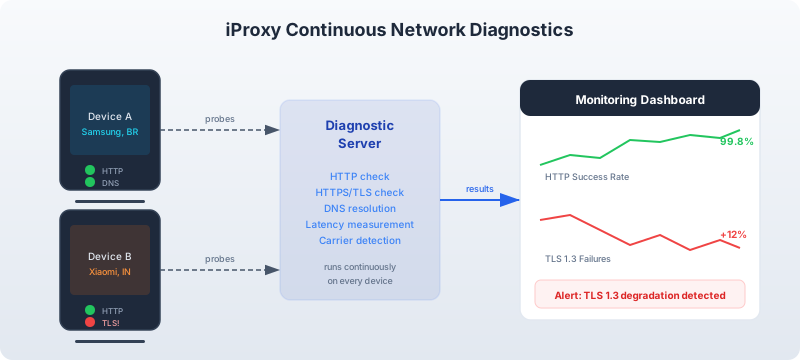
iProxy runs network diagnostics on every device. Constantly.
Our Android app doesn't just forward traffic. It runs a full suite of network health probes — checking connectivity, latency, DNS resolution, HTTP and HTTPS reachability, and more. These probes run continuously against controlled servers, so we know the state of every device's network at any given moment.
That's how we spotted it: a small percentage of devices started failing HTTPS checks while HTTP worked perfectly. The failure happened at the TLS handshake stage. No error, no timeout message — just a connection that silently went nowhere.
Without built-in diagnostics, this would've been invisible. Users would've seen intermittent proxy failures with no pattern and no explanation. We would've been guessing.
What was actually happening
The failures were tied to TLS 1.3 specifically. TLS 1.2 connections through the same device, to the same server, at the same time — worked fine. TLS 1.3 didn't.
The root cause turned out to be a combination of two things:
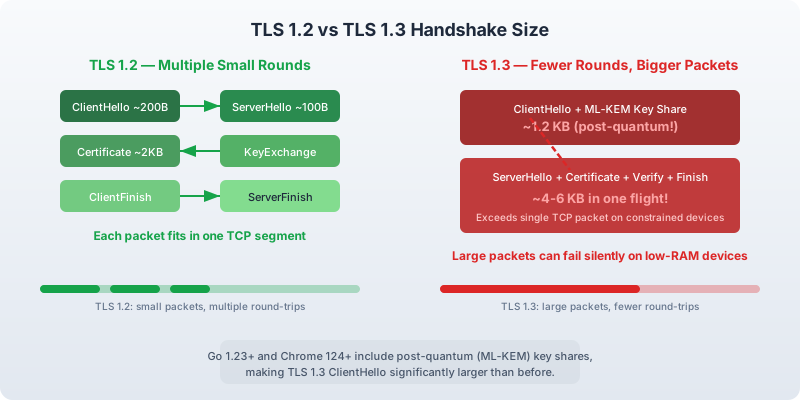
Modern TLS clients send much bigger handshake messages than they used to. Go 1.23+ and Chrome 124+ now include post-quantum cryptography key shares (ML-KEM) by default. This makes the very first message in a TLS connection — the ClientHello — large enough to exceed a single TCP packet. The server's response in TLS 1.3 is also sent as one big flight (certificate chain and all), which can be 4-6 KB for sites like Google or Cloudflare.
Android devices under memory pressure struggle to buffer these larger messages. Our app acts as a TCP proxy — it reads bytes from one socket and writes them to another. When the device is low on RAM, this buffering can fail silently. The handshake data either doesn't get forwarded, or the response doesn't make it back. No error. No crash. Just nothing.
TLS 1.2 avoids this entirely: its handshake is split across multiple smaller round trips, and no single message is big enough to cause problems.
Why this matters for proxy quality
This is the kind of issue that separates a reliable proxy service from a frustrating one.
Without active diagnostics, a provider would see users complaining about random HTTPS failures. Support would say "restart the app" or "check your internet connection." The issue would come and go. Nobody would connect it to TLS versions or device memory.
At iProxy, we detected the pattern automatically. Our diagnostic system identified that TLS 1.3 was failing while TLS 1.2 worked — on specific devices, at specific times. That told us exactly where to look.
What we did about it
Once we understood the problem, we shipped two fixes:
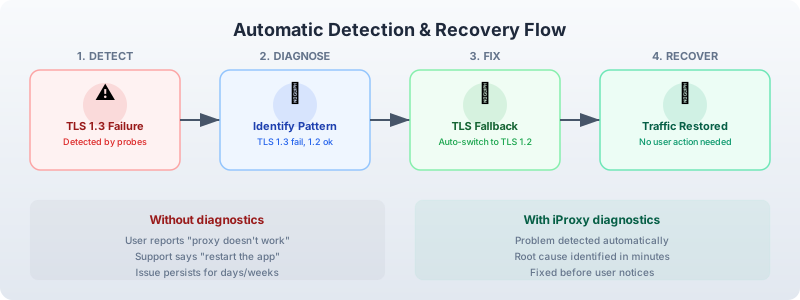
Smart TLS fallback. When our diagnostics detect the TLS 1.3 failure pattern on a device, we automatically adjust. Traffic keeps flowing without the user having to do anything.
Automatic recovery. If a device enters a degraded state, we can trigger a remote app restart to clear memory pressure and restore full functionality. The diagnostics detect when this is needed and handle it without user intervention.
We also tracked down and fixed memory leaks in our app that were contributing to the problem. The improvement was immediately visible in our monitoring dashboards — the rate of TLS 1.3 failures dropped significantly across the fleet.
This is what "managed proxy infrastructure" actually means
Anyone can write an app that forwards TCP packets. The hard part is knowing when it stops working, why it stopped working, and fixing it before the user opens a support ticket.
iProxy monitors network health on every device in real time. We don't wait for users to report problems — we detect them, diagnose them, and in many cases fix them automatically. That's the difference between a proxy app and a proxy infrastructure.
Our engineering team published a full technical deep dive into this investigation. If you're interested in the details — the packet captures, the Go vs curl differences, the post-quantum cryptography angle — you can read it here: When TLS 1.3 Silently Dies Inside Your Android Proxy.
iProxy.online provides mobile proxy infrastructure across 100+ countries and 600+ carriers. Our Android app turns phones into reliable proxy servers with built-in network diagnostics, automatic health monitoring, and remote management.
- Best Mobile Proxy Providers [2026]

- How to Set Up Remote Change of IP Address Through iProxy.online?
- How to Make Money With Proxies [The Complete Guide]
- How to Increase the Proxy Speed: Detailed Guide
- Guide for setting up mobile proxies in iProxy.online
- All about .OVPN configs, UDP, HTTP/3, QUIQ support
- What is Wi-Fi Split? How does it help to increase the speed and reduce traffic consumption?
- Replace passive OS fingerprint in mobile proxies
- List of recommended phones for iProxy.online
- How to choose the right location of the server?
 Sign up with Google
- Best Mobile Proxy Providers [2026]
- How to Set Up Remote Change of IP Address Through iProxy.online?
- How to Make Money With Proxies [The Complete Guide]
- How to Increase the Proxy Speed: Detailed Guide
- Guide for setting up mobile proxies in iProxy.online
- All about .OVPN configs, UDP, HTTP/3, QUIQ support
- What is Wi-Fi Split? How does it help to increase the speed and reduce traffic consumption?
- Replace passive OS fingerprint in mobile proxies
- List of recommended phones for iProxy.online
- How to choose the right location of the server?


